
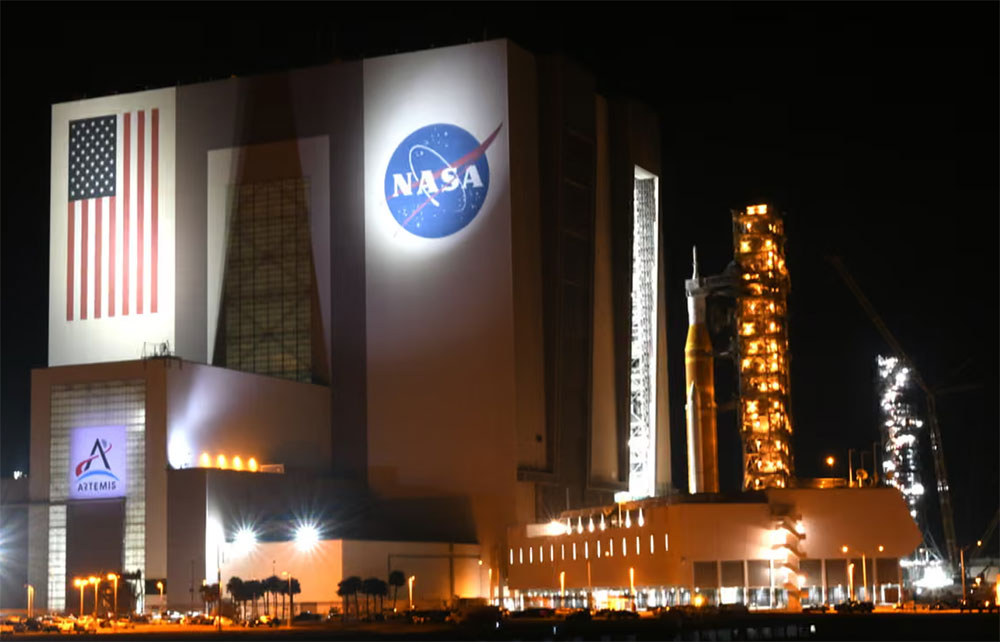
NASA Administrator Jared Isaacman announced on Friday a significant restructuring of the agency's Artemis lunar programme, acknowledging that the existing mission architecture carried too many untested variables to be executed safely and efficiently on its current timeline. The announcement came against the backdrop of yet another technical setback for Artemis II — the first crewed flight of the Space Launch System SLS and Orion spacecraft — which has now been pushed to no earlier than April 2026 following a series of propulsion and pressurisation issues discovered during pre-launch testing.
The core of Isaacman's "course correction" is the insertion of an additional mission between Artemis II and the planned lunar landing. What had been designated Artemis III will now be redefined as an Earth-orbit rendezvous and docking exercise, tentatively targeted for 2027. Under the revised plan, astronauts will rendezvous in low Earth orbit with the commercial lunar landers being developed by SpaceX and Blue Origin, conducting detailed verification of navigation, docking procedures, life support integration, propulsion systems, and communications — effectively mirroring the role Apollo 9 played in 1969 before the first lunar landing. The missions currently planned as Artemis IV and V, which would involve actual lunar landings, have been rescheduled to 2028.
The rationale Isaacman offered was straightforward: the gap between a lunar fly-by (Artemis II) and a lunar landing (the original Artemis III) represented too large a step, particularly when the SLS has averaged fewer than one flight per year since its 2022 debut. "Launching a rocket is important, and as complex as SLS is, every three years is not a path to success," Isaacman said, adding that infrequent launch cycles cause skills atrophy and loss of technical proficiency across the workforce. The new architecture is intended to increase launch cadence and allow teams to test critical systems in a more controlled environment before committing to deep-space operations.
The restructuring was also shaped by an independently critical assessment. NASA's Aerospace Safety Advisory Panel released a strongly worded report two days before Isaacman's announcement, citing concerns about the number of untested "firsts" embedded in the original Artemis III landing mission and recommending that the programme be restructured to establish a more balanced risk profile. Isaacman acknowledged the alignment between the panel's observations and the agency's own conclusions, though he stopped short of describing the two as coordinated.
The announcement, however, arrives at a moment when NASA's near-term credibility is being tested by the ongoing difficulties surrounding Artemis II itself. The mission — carrying NASA astronauts Reid Wiseman, Victor Glover, and Christina Koch alongside Canadian Space Agency astronaut Jeremy Hansen on a ten-day free-return trajectory around the Moon — has now slipped through three consecutive launch windows.
The first wet dress rehearsal in early February surfaced a persistent liquid hydrogen leak at the base of the SLS core stage, a problem that forced the termination of the simulated countdown with approximately five minutes remaining. Hydrogen leaks of a similar nature had delayed the Artemis I wet dress rehearsals in 2022, and while NASA engineers had worked to address the root causes in the intervening years, the molecule's exceptionally small atomic structure continues to present sealing challenges at cryogenic temperatures. Seal replacements and other pad-level repairs allowed a second wet dress rehearsal on 19 February to proceed successfully, and agency officials were briefly optimistic about a March launch.
That optimism was short-lived. On the Saturday following the second rehearsal, NASA announced it had detected a problem with the flow of helium — a gas used to pressurise fuel tanks and purge propellant lines — in the upper stage of the SLS rocket. Engineers identified potential causes in the interface between ground and rocket helium lines, a valve within the upper stage, and a filter in the ground-to-rocket pathway. NASA also noted it was reviewing data from comparable helium pressurisation issues encountered ahead of the Artemis I launch in 2022.
The decision was made to roll the integrated SLS and Orion stack back to the Vehicle Assembly Building for investigation and repair, a process that began on 25 February. The rollback effectively removed any possibility of a March launch date. NASA is now targeting an earliest launch of 1 April, with additional dates in April and potentially into May and June remaining under assessment, depending on how repair work progresses in the coming weeks. The four crew members, who had entered pre-launch quarantine in Houston in late January, have been released and will re-enter quarantine approximately two weeks before the next confirmed launch window opens.
For professionals in the aerospace sector, the technical details underlying these delays carry broader implications. The recurring propellant management challenges with SLS — both the hydrogen leakage and the helium flow anomaly — point to the difficulties inherent in operating a large, infrequently-flown launch vehicle with a complex ground interface. The SLS core stage uses a liquid oxygen and liquid hydrogen propellant combination that, while energy-dense, requires extensive sealing infrastructure maintained in near-perfect condition. The extended periods between flights mean that seals, valves, and interfaces are subject to environmental cycling without the benefit of frequent operational use to surface latent issues earlier in the processing flow.
The programme restructuring announced Friday reflects a broader philosophical shift at the agency under Isaacman's leadership. "We've got to get back to basics," he told CBS News, framing the new approach as a return to the incremental, test-before-you-fly methodology that characterised the Apollo programme's build-up. The decision to add a dedicated lander-docking mission in Earth orbit before attempting a lunar landing mirrors the logic that made Apollo 9 a necessary precursor to Apollo 11, testing the critical rendezvous and docking procedures in a lower-risk environment before they were needed 240,000 miles from home.
Commercially, the revised timeline has implications for SpaceX and Blue Origin, both of which hold contracts for the Human Landing System. Isaacman indicated that both companies are expected to conduct uncrewed landing demonstrations as part of their existing agreements, and that the new Artemis III docking mission in Earth orbit would allow NASA to rendezvous with both landers if scheduling permits — providing valuable operational data on both systems before committing to a crewed lunar descent. Which lander, or landers, will be used for the 2028 surface missions will depend on demonstrated readiness.
Whether the revised schedule holds will depend significantly on the outcome of repairs to the Artemis II vehicle over the coming weeks, and on NASA's ability to sustain the increased launch cadence Isaacman is now calling for. The agency is aiming to transition from a roughly 18-month launch interval to an annual cadence — a goal that will require sustained investment in workforce competency, ground system maintenance, and supply chain stability across the SLS and Orion programmes. Rebuilding that operational rhythm after years of extended inter-flight periods will be among the most consequential challenges the agency faces as it works toward returning humans to the lunar surface.
All launch dates are subject to change pending the outcome of ongoing technical reviews.